AI Prototypes.
Working prototypes I've built to solve real DesignOps problems. Each one is shown live, with the thinking behind it.
Demo access available on request.
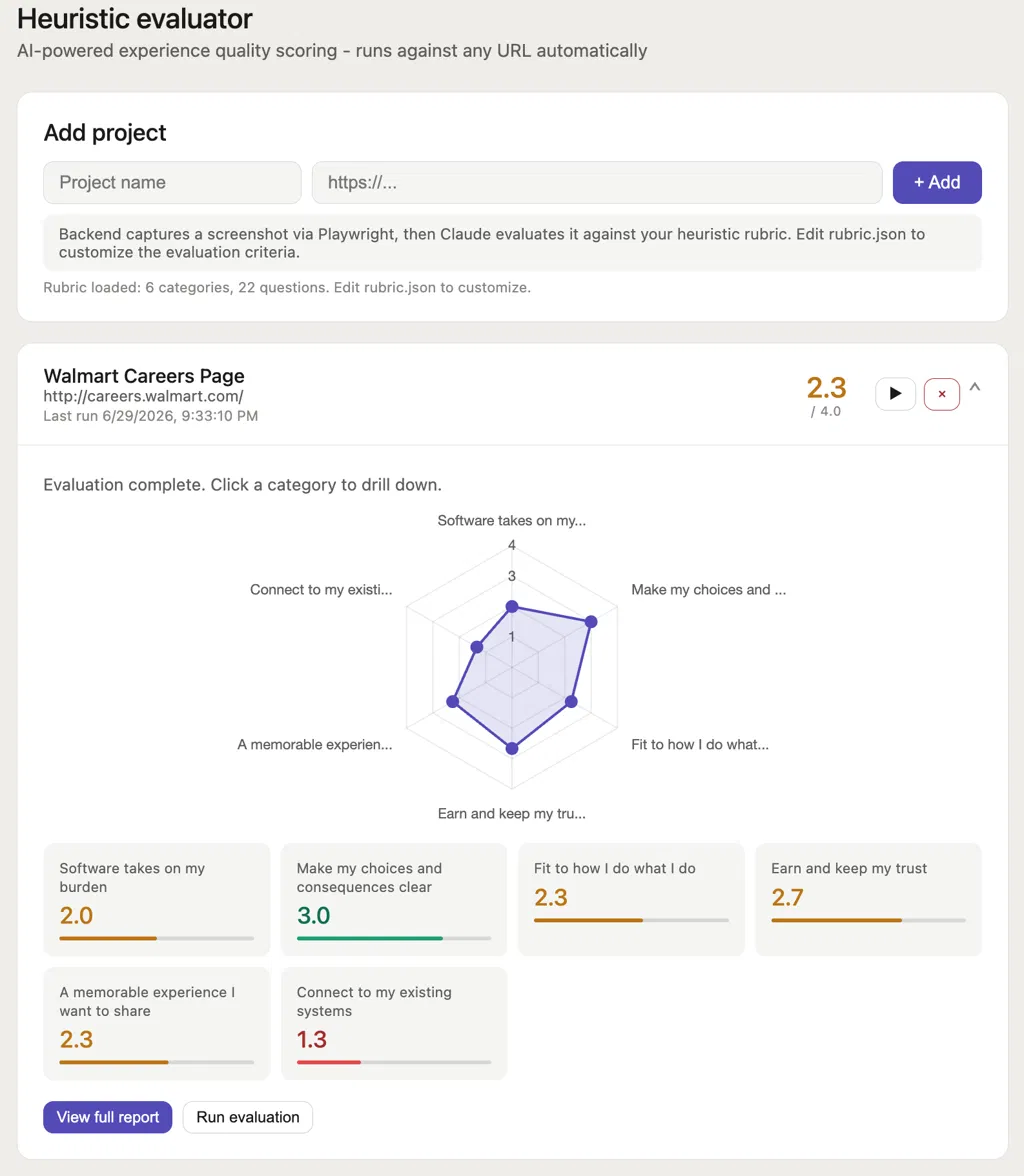
Heuristic Evaluator
Heuristic evaluation is one of the highest-leverage quality checks in design, but in practice it's slow, inconsistent, and bottlenecked on whoever happens to be free. So teams skip it and ship interfaces that were never systematically checked against their own standards.
An AI evaluator that scores an interface against a blend of Nielsen's 10 usability heuristics and the team's own design principles, returning structured, prioritized findings in minutes instead of days. The team's standards get encoded once and applied identically every time.
Today it evaluates one screen at a time. The next version walks an entire application systematically, so a full product can be assessed in a single pass instead of page by page.
Speed and consistency are the obvious wins. The compounding one is calibration: when the team sees the same standards applied to every review, those standards become muscle memory, and the quality bar rises across the whole org instead of living in one reviewer's head.
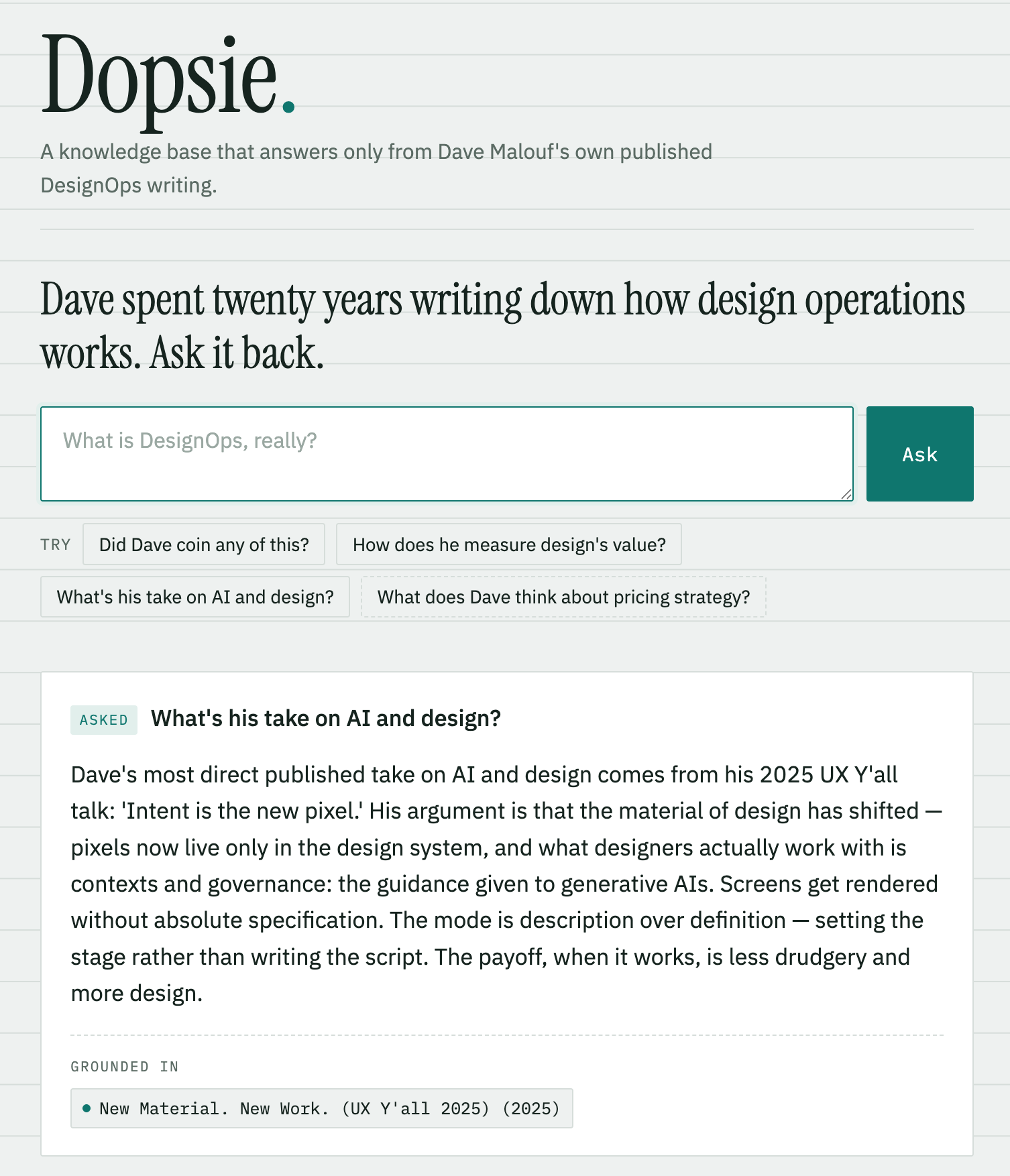
This prototype is seeded with my own DesignOps writing as a stand-in corpus, since I didn't have access to the team's internal content when I built it. The production version would point at the team's real playbooks.
Demo access available on request.
Dopsie
DesignOps knowledge, playbooks, standards, and the "how we work" lives in scattered docs and a few people's heads. Teams either can't find the playbooks that already exist or have gaps in their DesignOps fluency, and new hires take months to get oriented.
A chat interface that answers DesignOps questions in plain language, backed by a retrieval system (RAG) over a curated knowledge base. Ask a question, get an answer grounded in real source material instead of hunting through a wiki.
Generalize the knowledge base from my own writing to the design team's actual material, so it works as both an orientation tool for new hires and a living knowledge base for the whole team.
The core metric is time-to-knowledge. Faster answers mean fewer interruptions and less time lost searching; faster onboarding means new hires reach productivity sooner. Both effects compound as the team grows.
Can't we create an agentic OS for almost all of DesignOps' most basic and repeated tasks, like the ones above?
Email me if you are interested.