Living Clarity — an onboarding-first knowledge base, prototyped in Stitch.
A design-team knowledge base built for new associates on day one, valuable to veterans on day one thousand — and designed to be personalized by the home-office AI, Squiggly.
- Org
- Design org concept
- Role
- Product & Ops lead
- Year
- 2025
- Discipline
- Knowledge platform
Onboarding is where institutional memory leaks the most.
A new designer's first ninety days are a parade of questions that someone, somewhere, has already answered: how do we run a crit, where does research live, what's the bar for a Figma file, who owns the design system, what does the legal review path look like. Most of those answers live in Slack threads, one-off docs, and the heads of two or three veterans.
Living Clarity treats onboarding as the forcing function for an org-wide knowledge product — if it works for the brand-new associate, it works for everyone.
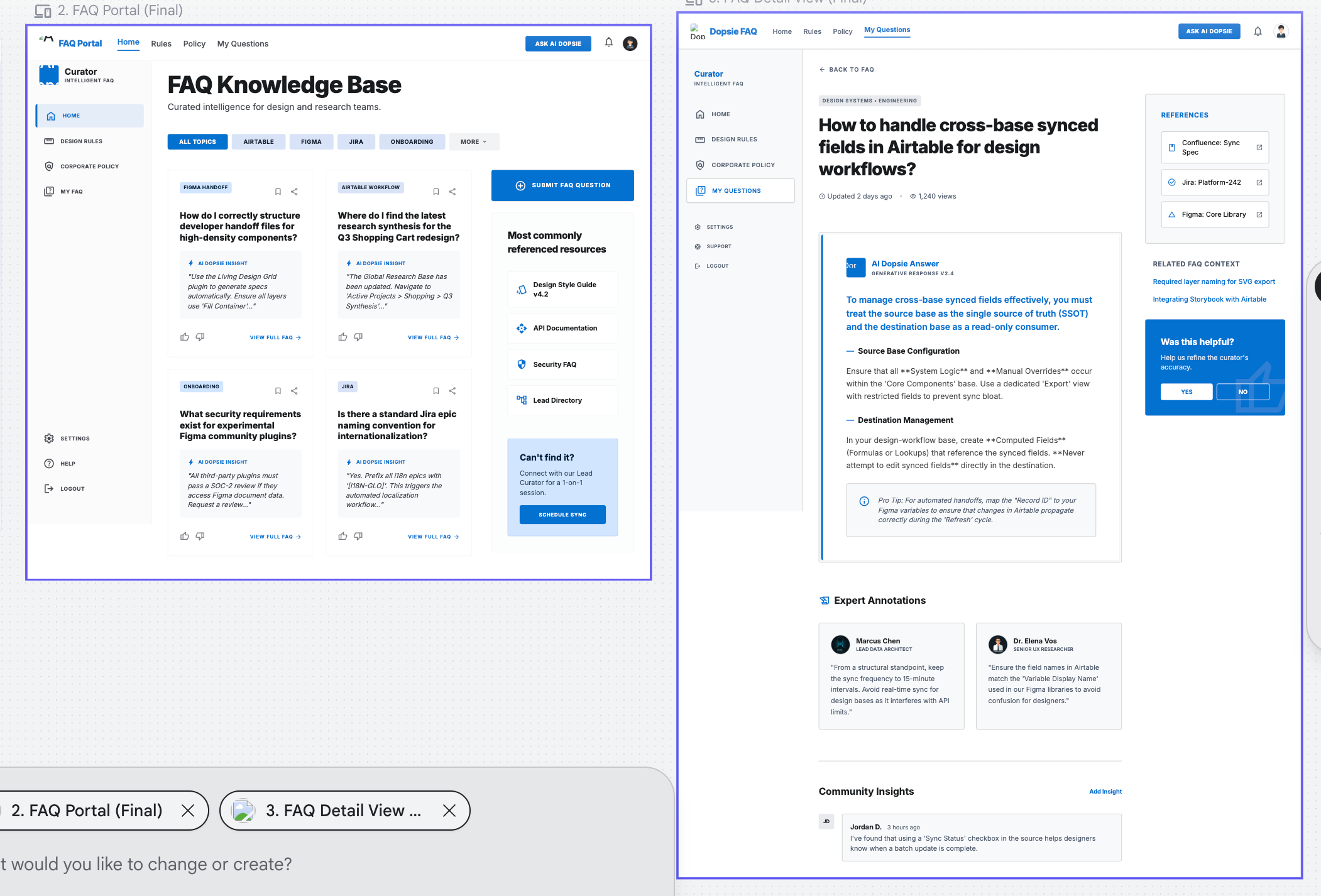
Prototyped end-to-end in Stitch.
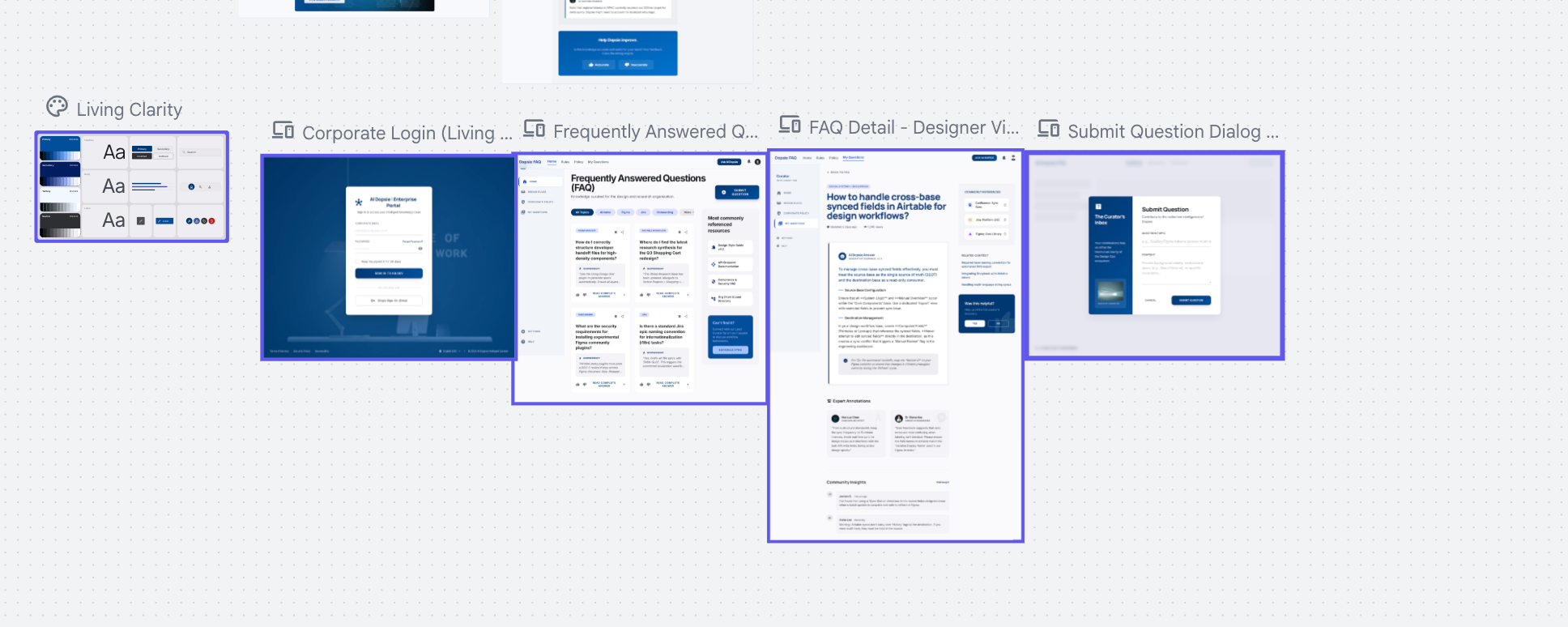
The screens here were generated and iterated inside Stitch, Google's AI design tool. Stitch let me move from a written product brief to a navigable, multi-screen prototype in hours — which is itself the point of the case study: the operating leader's job is no longer to wait for design capacity to test an idea. It's to prove the idea is worth design capacity in the first place.
Personalized by Squiggly, the home-office AI.
The static FAQ is the floor, not the ceiling. The vision is to wire Living Clarity into Squiggly, the home office's AI, so that every answer is personalized to the associate asking it — their location, their department, their role and function, their tenure, and the tools they actually have access to.
A new researcher in Seattle and a staff designer in Madrid ask "how do I kick off a research study?" and get two correct, different answers — same governed source, different surface. That's the difference between a knowledge base and an intelligent operating layer.
Designed for day one. If a new hire can self-serve, every existing associate benefits from the same surface.
Generated in Google Stitch. The leader proves the idea in working screens before spending design capacity on it.
Vision: answers personalized by location, department, role, and tenure — the same source of truth, tuned to the asker.
Onboarding time drops; institutional memory becomes a product.
With Living Clarity in place the onboarding ramp shortens, because new associates no longer need to find the right person to ask. More quietly: calibration tightens across the function, because decisions made on Tuesday are searchable — and personalized — on Wednesday. The function moves from "ask three people and hope" to "ask once, get the answer scoped to you."
How this maps to leadership principles.
- Customer Obsession: the new associate is the customer of DesignOps. Living Clarity is the product that respects their first ninety days.
- Invent and Simplify: a Stitch prototype of a personalized knowledge layer is a simpler operating move than commissioning a quarter of design work to scope it.
- Learn and Be Curious: pulling Stitch and Squiggly into the operating leader's toolkit is exactly the kind of capability the role now demands.
- Deliver Results: shorter onboarding ramps and fewer re-litigated decisions are operational gains, not vanity metrics.